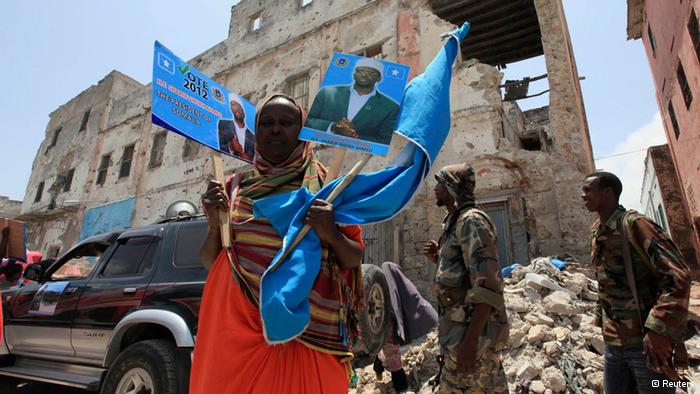
The
election of a new president is supposed to end violence and anarchy in Somalia.
But the war-torn country is still dogged by violence and corruption, and
experts don't expect that to change any time soon.
When the
new man at the helm of war-troubled nation of Somalia is elected, a sigh of
relief will be heard from UN headquarters in New York all the way to Mogadishu.
Many observers had feared the latest attempt to form a government had failed
after lawmakers missed the August 20 deadline to elect a new head of state.
Apparently, it was the United States that forced the Members of Parliament to
give in and carry out the election. The vote of Somali MPs marks the end of the
agonizing transitional period to set up a new administration.
Bribes are
all too common
Questions
however remain whether the administration can make a difference in the country
that has been without a functioning government for more than 20 years. The
parliamentary election last month was seen as a test run for the presidential
elections. The polls however revealed that many of the chronic ills of Somali
politics are still alive and well: Many Members of Parliament reportedly did
not get a seat because of their competency, but because of "brown
envelopes" - bribes of about $60,000 (47,000 euros) each.
 |
| Members of Somalia's parliament are said to have paid bribes |
Legal
expert Mohamed Osman Jawari was subsequently elected speaker - a post that
traditionally carries much weight in Somalia. He is one of the experts tasked
with drafting the new constitution. Many experts however doubt that the current
draft is acceptable to the majority of Somalis.
"Most
of the key issues raised in the draft such as federalism or the role of Islam
in Somali politics have been edged out," Roland Marchal of the Centre for
International Studies and Research in Paris told DW. Instead, the new
parliament has to debate these issues again from scratch. "After eight
years of negotiations, you can hardly call that a success," Marchal said.
A helpless
international community
The
troubled transitional process shows how helpless the international community
still is in Somalia. The UN Political Office for Somalia (UNPOS) was supposed
to moderate the process. But the office is mired in so many disputes that
Somalis called on UN Secretary General Ban Ki Moon to sack his special
representative to the country, Augustine Mahiga.
At the same
time, many Somalis doubt the motives of the international community. They fear
that countries such as Norway are more interested in the country's fish grounds
or recent oil finds than in establishing a functioning government. Many
observers fear that large parts of the population will lack trust in the new
government set up with assistance from the international community.
Campaigning,
Somalia style
 |
| The UN has accused President Sharif Sheikh Ahmed of corruption |
In the last
days and weeks, contenders for the presidential post met regularly amidst the
hustle and bustle of Somalia's capital Mogadishu to forge alliances. Just like
before, ethnicity mattered more than ideology in these campaigns. 25 candidates
had registered as candidates by September 7, which marks the official deadline.
They included former prime ministers, business men and academics. Even the head
of the BBC's Somali Service decided to leave his desk in London in favor of a
campaign office in Mogadishu. On the weekend, the candidates officially
introduced themselves to parliament. Sunday was their official campaigning day.
Most of the
candidates are familiar faces in Somali politics. Many observers doubt that
they stand for a new beginning in the war-torn nation. "There are two many
cooks in the kitchen that are not trained to cook in the first place,"
Somalia expert Markus Höhne from the Max-Planck-Institute told DW.
Somalia's
previous transitional governments have also failed to raise hope that Somali
politics have changed for the better in recent times. Incumbent president
Sharif Sheikh Admed has been heading a corrupt and inefficient administration
since 2009. A leaked UN report accuses his government of "systematic
embezzlement, pure and simple misappropriation of funds and theft of public
money." Between 2009 and 2010, the government stole seven out of every ten
dollars of public funds. Besides corruption, observers are also deeply worried
about the country's human rights situation. Germany's Society for
threatened peoples calls it "disastrous."

No comments:
Post a Comment
Note: Only a member of this blog may post a comment.