Yahoo – AFP,
Emile Costard, 7 April 2015
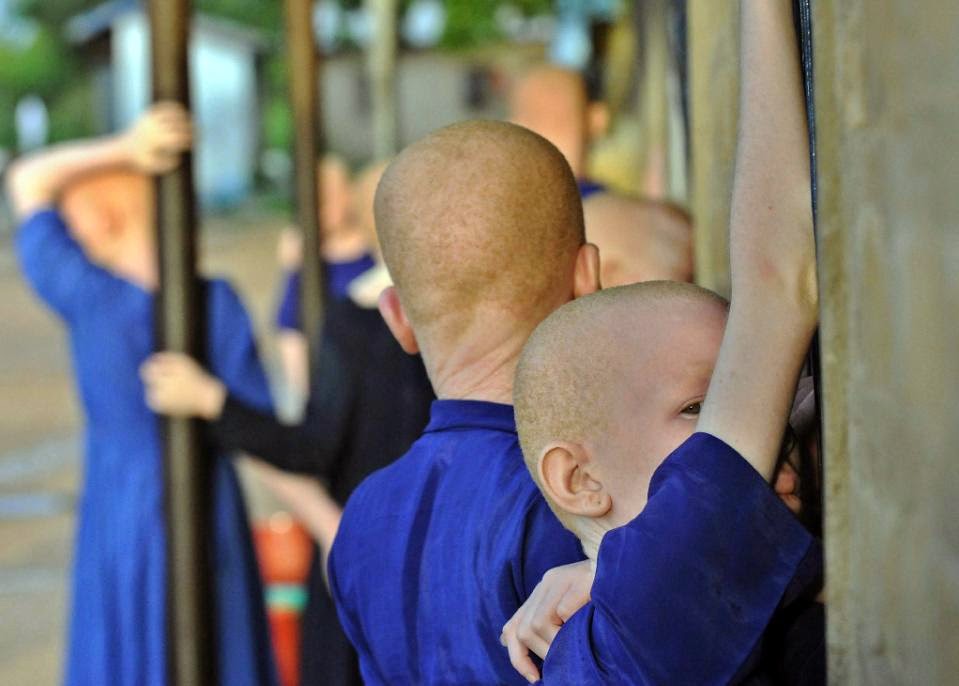 |
Their limbs
hacked off and babies and children abducted or killed, albinos in
Tanzania live
in fear of another horrific spate of attacks against them ahead
of elections in
October (AFP Photo/Tony Karumba)
|
Dar es
Salaam (AFP) - Their limbs hacked off and babies and children abducted or
killed, albinos in Tanzania live in fear of another horrific spate of attacks
against them ahead of elections in October.
Albino body
parts are boiled up in foul human potions for witchcraft in the east African
nation, and reports of killings have increased as local politicians order their
spells in the belief that the expensive brews will secure poll victory.
"Local
political leaders believe in the power of witchdoctors and think that it could
help them to win elections," said Vicky Ntetema, director of Under The
Same Sun, an organisation defending the rights of albinos in Tanzania.
With an
entire corpse selling for as much as $75,000 (70,000 euros), Ntetema claims the
high price is an indication that "some political and economic elites"
could be involved in albino murders.
In one
recent attack, a six-year-old albino boy's hand was chopped off with a machete
and his mother assaulted as she tried to protect him.
At least 76
albinos have been murdered since 2000 with their dismembered body parts selling
for hundreds of dollars, according to United Nations experts.
A further
34 albinos have survived after having parts of their bodies hacked off, and
grave robbers have dug up at least 15 more albinos, seeking buried limbs and
bodies.
Forced to
flee
Sengerema
Simon, a 28-year-old man with albinism, was forced to flee his village in
Tanzania's northern Tabora region fearing he would be attacked and cooked.
"In
the village, I often heard people just call me 'the albino', then one day men I
did not know called me by my name, saying they were going to do business... I
was very scared," he told AFP.
Unemployed,
he now ekes out a living in the commercial capital Dar es Salaam with help from
the Tanzania Albinism Society.
Albinism is
a hereditary genetic condition which causes a total absence of pigmentation in
the skin, hair and eyes.
It affects
one Tanzanian in 1,400, often as a result of inbreeding, experts say. Tanzania
is home to some 49 million people.
Many
attacks take place in northwestern Tanzania among the Sukuma people, the
country's largest ethnic group and one with a long belief in witchcraft.
But experts
say a thriving informal mining industry has also driven the killings, with
prospectors desperate for anything that could help them strike it rich.
"The
murders are connected to gold and diamond miners' efforts to secure lucky
charms for finding minerals and protection against danger while mining," a
2010 report by the British-based Journal of Modern African Studies said.
In Africa,
albinos generate a mixture of fear and fascination: some are stigmatised for
their different colour, others treated almost as "divine figures,"
said Giorgio Brocco, an expert at Germany's Free University of Berlin.
"In
some part of Africa, some ethnic groups originally believed that people with
albinism disappeared instead of dying -- or that they are gods," Brocco
said.
Stigma
from birth
Not in
Tanzania, however, where they have "mostly been discriminated
against" because they cannot so easily take part in farming, as their skin
burns in the fierce sun, Brocco added.
 |
Josephat
Torner, 32, who works for the Tanzania's Albino Society, speaks on
March 12,
2015 in Dar es Salaam about discrimination and threats against the
albino
population (AFP Photo/Emile Costard)
|
That stigma
begins at birth, said Josephat Torner, 32, who has albinism and works for the
country's Albino Society.
"When
I was born, the community wanted to poison me. People thought I was a bad omen
for the village... but my mother stopped them and saved my life."
Torner
recalls how growing up he was ostracised for his looks.
"Children
didn't want to play with me because they thought I could contaminate them, even
my own brothers didn't touch my clothes for the same reasons," he said.
Campaigners
say that education and raising awareness are vital in changing beliefs and
prejudice.
"You
may apply for a post of employment... you may have all the qualifications and
experience, but you will never get employed because of negative
attitudes," said Kondo Seif, who works for Under the Same Sun.
Seif, a top
student at the University of Dar es Salaam, says he was denied a scholarship
and teaching post after studying "because of my condition."
Still Seif
is optimistic that attitudes are slowly changing, at least in urban areas.
"Bad
reactions in a restaurant or a bar were very common in the past but not so much
now," he said.
In March,
Tanzanian police rounded up hundreds of witchdoctors in a bid to stem the
albino murders.
But
campaigners such as Torner -- who travels regularly around remote northern
regions to raise awareness about albinism -- say that in the long-term, it will
be education that will "eliminate the false beliefs."
No comments:
Post a Comment
Note: Only a member of this blog may post a comment.