 |
| Somes villagers in western Kenya are receiving a universal basic income, an experimental programme by the American NGO Give Directly as a way to reduce poverty (AFP Photo/Yasuyoshi CHIBA) |
Bondo (Kenya) (AFP) - Until recently, Molly struggled to imagine life beyond the end of each repetitive day: work in someone else's fields and earn enough to eat, rinse, repeat.
"It
was a vicious circle I could not escape," says the 25-year-old villager in
the Bondo region of western Kenya.
Her hardscrabble,
rural existence is the same for many in Siaya County where people eke out a
living farming maize, millet and cotton in the ochre soil.
But that
was before the introduction in her village of a cash handout known as
"universal basic income". It's part of a large, intensive, multi-year
study aimed at discovering a new way to end poverty in Africa.
Molly began
receiving a no-strings, fixed monthly donation of 2,250 shillings ($22, 19
euros) two years ago, and since then "everything has changed", she says.
"I was
able to save to study to be a nursery school teacher," she says proudly
inside her tin-roofed cement home as chickens pecked outside.
"It
was the little bit of help that turned my situation around."
With a paid
internship at the village school Molly has built on the foundation of universal
basic income to see her monthly income more than double to $50, broadening her
horizons.
"Before,
I barely had enough money to survive but now I have plans... I even go to the
hairdresser once every two months," she says with a smile.
 |
| 25-year-old Molly has used her universal basic income to study to be a nursery school teacher (AFP Photo/Yasuyoshi CHIBA) |
Same
cash, different dreams
According
to the World Bank, over a third of Kenya's nearly 50 million citizens live
below the international poverty line of $1.90 a day.
Molly's village
-- which is not being identified in order not to stir envy or skew the study --
is one of scores in the area chosen by the US charity Give Directly to test the
universal basic income theory.
The region
was selected because of its poverty, but also its stability and, crucially, the
effectiveness of Kenya's mobile money transfer system, M-Pesa, that allows the
easy distribution of payments.
Founded in
2010 and working in six African countries, Give Directly sends money straight
to the poor allowing them to choose their own priorities, rather than outsiders
"deciding instead of them", explains the non-profit's spokeswoman
Caroline Teti.
Previously,
recipients were given a single lump sum, but now monthly payments are being
trialed.
"When
you give people money monthly, will they stop working? Will they take risks in
the way they invest knowing they will have an income whatever happens? How does
that affect their aspirations?" says Teti of some of the questions their
programme is testing.
"There is a global debate about universal income and we want evidence to move forward," she says.
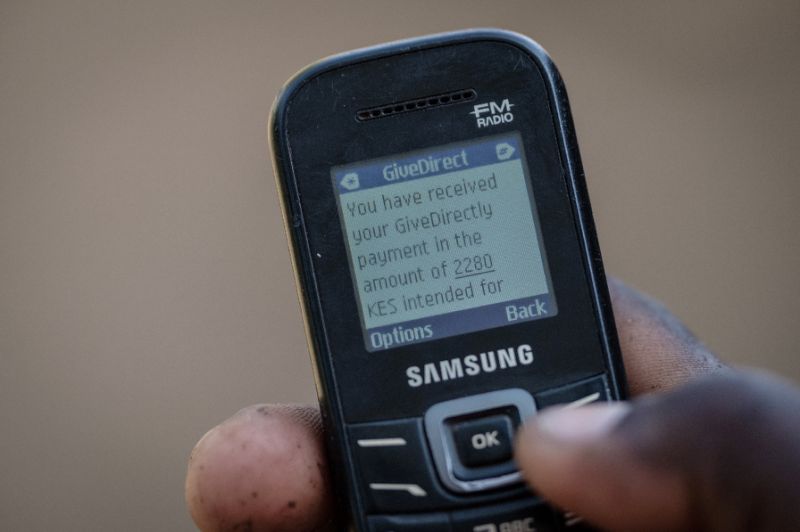 |
A villager
shows his mobile phone's monitor displaying a message confirming the
universal
basic income transaction, 2,250 shillings per month ($22,19 euros)
(AFP
Photo/Yasuyoshi CHIBA)
|
"There is a global debate about universal income and we want evidence to move forward," she says.
The study
is the biggest in the world and will involve a total of 20,000 people in
western Kenya.
Residents
of 40 villages will receive $22 a month for 12 years, a further 80 villages
will receive the same amount for just two years, while another 76 villages will
receive two lump sum payments of $507 spaced two months apart.
Molly's
neighbour, 29-year-old Edwin, hopes to replace his mud hut with a cement home,
while Monica and her husband have invested in small-scale chicken farming.
"We
have a new enclosure and a few chickens," says Monica, 30, wearing an
elegant black dress, mended in several places. She hopes to be able to send her
three children to school so that they won't "live in poverty, like
us".
Without
patronising prescriptions from donors, "everyone in the village is using
the money differently," she adds.
'Not the
sole solution'
Give
Directly believes universal basic income is useful, but not a panacea.
 |
30-year-old
Monica, hopes to send her children to school so they won't "live in
poverty, like us" (AFP Photo/Yasuyoshi CHIBA)
|
"When
you are in a conflict situation, you may have been affected beyond basic
(needs), you may not have a place to sleep, you're more vulnerable to
disease," says Teti.
"In
that context, basic income can be a part of a solution, but it cannot be the
sole solution."
Nor, she
adds, is it a substitute for the state's obligations to provide life's basics
such as schools and healthcare.
For
villagers involved in the basic income experiment, the money is an assist not a
solution, and also an opportunity, to be seized or squandered.
"2,250
shillings is not enough to buy useless things," says Judge Samson, 72,
explaining why villagers are not wasting their cash handouts. "It's just
enough to feed you and get out of poverty."
Monica has
invested her money to benefit her family, but worries that if the basic income
trial is a success, others might prove less thrifty.
"Maybe
in the future some will forget what we went through and start buying stupid
things," she warns, but then adds: "I don't think that will be the
case."
VIDEO: Residents of rural Kenya are reaping the benefits of a trial programme involving the distribution of universal basic income to people in poor regions pic.twitter.com/XSamftZr5i— AFP news agency (@AFP) October 28, 2018
No comments:
Post a Comment
Note: Only a member of this blog may post a comment.